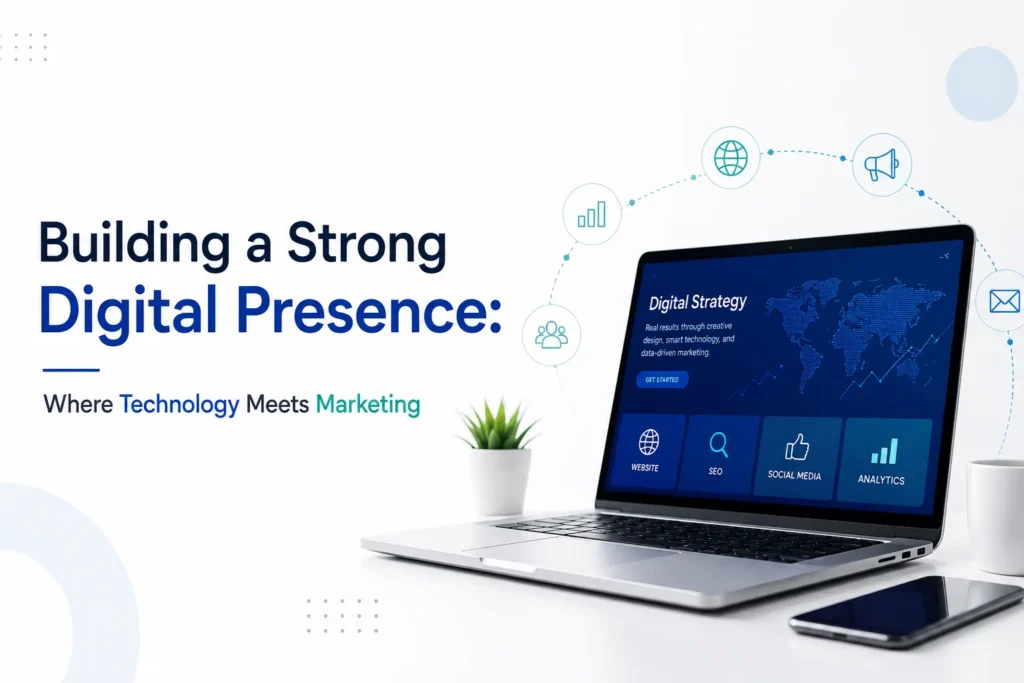
Building a Strong Digital Presence: Where Technology Meets Marketing
Introduction
Having a great website, application, or digital product is only one part of building a successful online business. The next challenge is getting the right people to discover it.
This is where digital marketing becomes essential.
Customers today use search engines, social media, online reviews, videos, advertisements, and content to research businesses before making decisions. A company that wants to grow digitally needs to be visible across the channels where its customers are already spending their time.
Digital marketing connects your technology with your audience. It helps businesses attract potential customers, build trust, generate leads, increase conversions, and develop long-term relationships.
But successful digital marketing isn’t simply about running advertisements or posting regularly on social media. It requires a combination of strategy, content, technology, data, and continuous optimization.
Your Digital Presence Starts With Visibility
A business can offer an excellent product or service and still struggle to grow if potential customers cannot find it.
Imagine a customer searching for a service that your company provides. If your website doesn’t appear in the search results, your competitors are likely to receive that opportunity instead.
Visibility is the first step toward creating digital growth.
Search engines, social media platforms, online directories, content platforms, and paid advertising can all help businesses reach their target audience.
The important part is understanding where your potential customers are searching and creating a strategy around those channels.
A local service business may benefit from local SEO and Google visibility. An e-commerce brand may focus heavily on social media, search advertising, and product campaigns. A B2B company may prioritize SEO, LinkedIn, content marketing, and lead-generation campaigns.
The right channel depends on the audience and the business model.
SEO Helps Customers Find You When They Are Searching
Search Engine Optimization remains one of the most valuable long-term digital marketing strategies.
When someone searches for a product, service, solution, or answer, they are already expressing some level of intent.
SEO helps businesses appear at the right moment when potential customers are actively looking for something they provide.
Effective SEO goes beyond adding keywords to a webpage.
It involves understanding search intent, creating useful content, optimizing website structure, improving technical performance, building authority, and continuously analyzing search behavior.
For example, a software development company could create content around topics such as website development, mobile app development, cloud solutions, automation, and business technology.
Over time, these resources can attract people who are actively researching those solutions and introduce them to the business.
Content Builds Trust Before the Sales Conversation
Customers rarely make important decisions based on a single advertisement.
They research.
They compare.
They read.
They watch videos.
They look at reviews.
They explore websites.
This makes content an important part of the customer journey.
Good content answers questions before customers even speak with your sales team.
A business can use blog articles, case studies, guides, videos, social media posts, infographics, newsletters, and other formats to demonstrate its knowledge and help potential customers make informed decisions.
For example, instead of simply saying that your company provides web development, you can publish content explaining how businesses can improve website performance, what makes a good website, or how to choose the right development approach.
That content provides value while also demonstrating expertise.
Social Media Creates Ongoing Brand Visibility
Social media gives businesses an opportunity to communicate with their audience consistently.
But effective social media marketing isn’t about posting something every day just to remain active.
The goal should be to create content that people find useful, interesting, informative, or worth sharing.
Different platforms serve different purposes.
Some businesses may use Instagram to showcase visual content and products. Others may use LinkedIn to build professional authority. YouTube can be useful for educational or product-focused video content, while other platforms may help businesses reach broader audiences.
The strategy should follow the audience rather than forcing the business to be everywhere.
Paid Advertising Can Accelerate Growth
Organic marketing strategies can take time.
Paid advertising can help businesses reach targeted audiences much faster.
Platforms such as search engines and social networks allow businesses to target users based on factors such as interests, demographics, location, behavior, and search intent.
The advantage of paid advertising is not simply reaching more people. It is reaching more relevant people.
However, successful advertising requires more than increasing the budget.
Campaign performance depends on the quality of the audience, messaging, creative, landing page, offer, tracking, and conversion process.
A campaign that generates thousands of clicks but no meaningful leads is not necessarily successful.
The real objective is to connect advertising spend with measurable business outcomes.
Your Website and Marketing Should Work Together
Digital marketing becomes significantly more effective when the website and marketing strategy are designed to work together.
An advertisement may attract a visitor, but the landing page determines what happens next.
If the page loads slowly, contains unclear information, or doesn’t provide a relevant next step, the marketing campaign may lose potential customers.
Your website is often where marketing traffic becomes business value.
The relationship can be simple:
Marketing attracts the visitor → Website builds trust → Content provides information → CTA creates action → CRM captures the lead → Sales team follows up.
When these components are connected, businesses can create a much more efficient customer journey.
Landing Pages Can Improve Campaign Performance
Sending every advertising visitor to the homepage isn’t always the best approach.
A landing page can be designed around a specific campaign, audience, service, or offer.
For example, an advertisement promoting mobile app development could lead to a dedicated page focused specifically on app development rather than a general homepage.
The visitor immediately sees relevant information.
The more closely the landing page matches the customer’s intent, the easier it becomes to create a focused conversion experience.
Effective landing pages typically have a clear message, relevant visuals, strong trust signals, concise information, and a prominent call to action.
Data Turns Marketing Into a Measurable Process
One of the biggest advantages of digital marketing is the amount of data available.
Businesses can track where visitors come from, which campaigns generate traffic, how users interact with pages, which content receives attention, and which channels produce conversions.
Data allows businesses to move from assumptions to informed decisions.
Suppose one campaign generates 10,000 visitors but only a few leads, while another generates 2,000 visitors and produces significantly more qualified enquiries.
The second campaign may actually be more valuable despite generating less traffic.
This is why businesses should focus on meaningful metrics rather than vanity numbers.
Understanding the Customer Journey
Not every visitor is ready to become a customer immediately.
Some people are discovering the business for the first time. Others are researching different options. Some are comparing competitors, while others are ready to make a decision.
Digital marketing works best when it supports customers throughout this journey.
A simplified journey might look like:
Awareness → Interest → Research → Consideration → Conversion → Retention
Different marketing activities can support different stages.
Educational content can help during awareness and research.
Case studies and testimonials can support consideration.
Offers, consultations, and strong calls to action can encourage conversion.
Email marketing, loyalty programs, and personalized communication can support retention.
Automation Can Make Marketing More Efficient
As marketing activities grow, manually managing every interaction becomes difficult.
Automation can help businesses handle repetitive tasks while allowing teams to focus on strategy and customer relationships.
For example, when someone submits a form, an automated workflow could capture the lead, send a confirmation email, update the CRM, notify the sales team, and schedule a follow-up.
Marketing automation creates consistency while reducing repetitive manual work.
Businesses can also use automation for email campaigns, customer segmentation, lead nurturing, reporting, and follow-up workflows.
When combined with APIs, CRM systems, and modern automation platforms, marketing can become part of a connected business process.
AI Is Changing Digital Marketing
Artificial intelligence is becoming increasingly important across the marketing ecosystem.
AI can assist businesses with content research, customer segmentation, campaign analysis, personalization, chatbots, recommendations, customer support, and workflow automation.
But AI should not replace strategy.
The most effective approach is to use AI to improve efficiency while keeping human creativity, judgment, and brand understanding at the center.
For example, AI can help analyze large amounts of customer data and identify patterns, while marketers can use those insights to create better campaigns and experiences.
Consistency Builds a Stronger Brand
A business may use several marketing channels, but customers should still feel like they are interacting with the same company.
Visual identity, messaging, tone, positioning, and customer experience should remain consistent across the website, social media, advertisements, emails, and other communication channels.
Consistency helps create recognition and strengthens trust over time.
A customer who discovers a company through an advertisement should experience the same brand when they visit the website or social media profile.
This creates a more professional and connected digital presence.
Digital Marketing Is an Ongoing Process
One of the biggest mistakes businesses make is treating marketing as a one-time project.
Launching a website, running one advertising campaign, or publishing a few social media posts doesn’t create a sustainable marketing strategy.
Digital growth requires continuous testing, learning, and optimization.
Campaigns need to be analyzed. Content needs to be updated. Landing pages can be improved. New customer behaviors need to be understood. Search trends change. Platforms evolve.
The businesses that continuously learn from their data and adapt their strategy are more likely to build sustainable growth.
Building a Digital Marketing Strategy That Works
A successful strategy doesn’t need to use every available platform.
It needs to use the right combination of channels for the business.
A practical approach can begin with:
Understanding the audience — Identify who your customers are, what they need, and how they make decisions.
Defining business objectives — Determine whether the priority is awareness, leads, sales, engagement, or retention.
Choosing the right channels — Focus on the platforms where your audience is most active.
Creating valuable content — Answer questions and demonstrate expertise.
Optimizing the website — Make sure marketing traffic has a strong destination.
Tracking performance — Measure meaningful results.
Continuously improving — Use data to refine campaigns and customer experiences.
This creates a marketing system rather than a collection of disconnected activities.
The Future of Digital Marketing
Digital marketing will continue to become more personalized, automated, and data-driven.
AI-powered experiences, intelligent automation, predictive analytics, personalized content, conversational interfaces, and integrated customer platforms are already changing how businesses communicate with their audiences.
At the same time, customers are becoming more selective about the content they consume and the businesses they trust.
The future of digital marketing will belong to businesses that combine technology with genuine customer value.
Technology can help businesses reach people faster, understand them better, and automate processes—but meaningful communication and a strong customer experience will remain essential.
Final Thoughts
Building a strong digital presence isn’t about choosing between a website, social media, SEO, advertising, or content marketing.
The strongest digital strategies bring these elements together into one connected customer journey.
Your website provides the foundation. SEO helps people discover you. Content builds authority. Social media creates engagement. Advertising accelerates reach. Analytics provide insights. Automation improves efficiency.
When these elements work together, digital marketing becomes more than promotion.
It becomes a system for attracting, engaging, converting, and retaining customers.
At Arora Tech Solutions, we help businesses combine technology and digital marketing to create stronger online experiences. From websites and applications to SEO, digital campaigns, automation, and data-driven strategies, our focus is on building solutions that support measurable business growth.
Being online is no longer enough. Your digital presence should work for your business.
Ready to Build a Stronger Digital Presence?
Let’s create a digital strategy that connects your business with the right audience and turns online opportunities into real growth.
Start a Project →