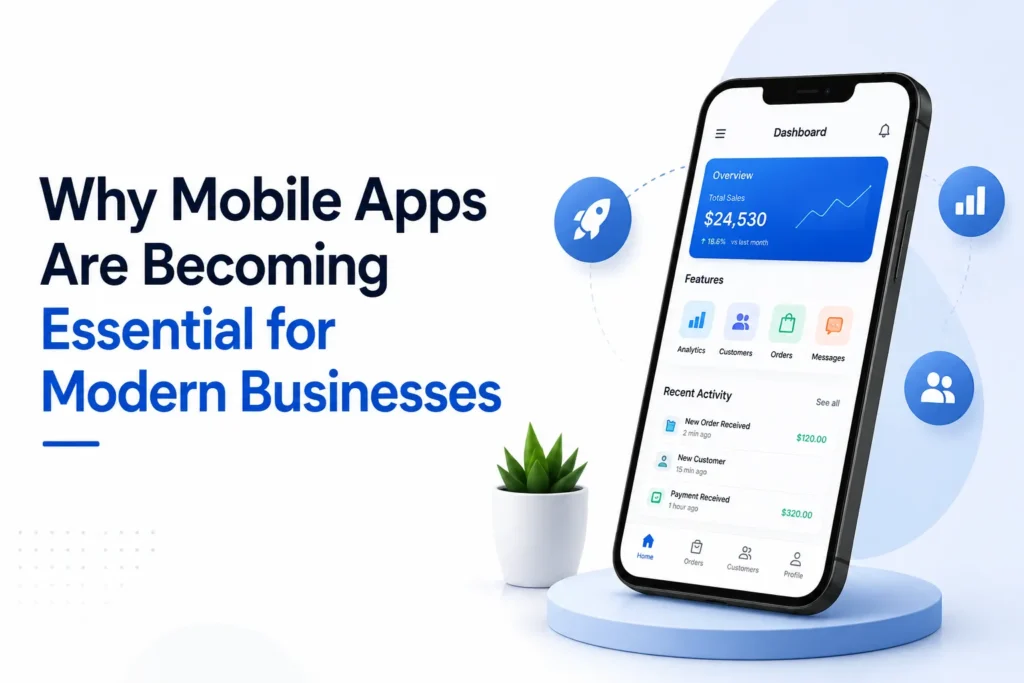
Why Mobile Apps Are Becoming Essential for Modern Businesses
Introduction
Smartphones have become one of the most important ways people interact with businesses. Customers use mobile devices to discover products, make purchases, book services, communicate with companies, manage accounts, and access digital platforms throughout the day.
As customer expectations continue to evolve, businesses are looking beyond traditional websites and exploring mobile applications as a way to create more direct and personalized digital experiences.
A well-designed mobile app can become more than another digital channel. It can become a direct connection between a business and its customers.
From e-commerce and banking to healthcare, education, travel, entertainment, and business operations, mobile applications are helping organizations create faster, more convenient, and more engaging experiences.
Why Mobile Apps Matter for Modern Businesses
A website provides an important foundation for a digital presence, but an application can provide a more controlled and personalized environment.
Once a customer installs an app, the business has a direct channel through which it can provide services, communicate updates, personalize experiences, and encourage repeat engagement.
The real value of a mobile application isn’t simply having an app in the App Store or Play Store. It is creating a useful digital experience that customers genuinely want to return to.
An effective app should solve a real problem, simplify an existing process, or provide functionality that is difficult to deliver through a traditional website.
Mobile Apps Create a More Direct Customer Experience
Websites require customers to open a browser, search for a business, and navigate to the required service. Mobile applications can reduce these steps by placing the experience directly on the customer’s device.
For example, an e-commerce application can allow customers to browse products, save favorites, receive personalized recommendations, and complete purchases without repeatedly navigating through a browser.
Similarly, a healthcare application could allow patients to manage appointments, access relevant information, receive reminders, and communicate with healthcare providers through a single platform.
The closer the digital experience is to the customer’s everyday needs, the more valuable the application becomes.
Personalization Can Improve Engagement
One of the biggest advantages of mobile applications is the ability to create more personalized experiences.
An app can remember user preferences, previous interactions, purchase history, saved items, location preferences, and other relevant information.
This allows businesses to present users with content and functionality that is more relevant to them.
For example, a retail application can recommend products based on previous purchases. A fitness application can adapt recommendations based on user activity. A learning platform can suggest content based on a student’s progress.
Personalization turns a generic digital experience into something that feels more relevant to each individual user.
Push Notifications Keep Customers Connected
One of the most recognizable advantages of mobile applications is push notifications.
Unlike traditional marketing channels, notifications can reach customers directly on their devices.
Businesses can use them for useful updates such as order confirmations, delivery information, appointment reminders, new product announcements, important account updates, or personalized offers.
However, effective notification strategies are about relevance rather than volume.
Sending too many irrelevant notifications can quickly cause users to disable notifications or uninstall the application.
The goal should be to provide timely information that adds value to the customer’s experience.
Mobile Apps Can Improve Customer Loyalty
Customer retention is often just as important as customer acquisition.
A mobile application can help businesses create experiences that encourage customers to return.
Loyalty programs, personalized recommendations, rewards, saved preferences, subscriptions, exclusive offers, and convenient reordering can all contribute to stronger customer relationships.
For example, a restaurant application could allow customers to save favorite meals, reorder previous purchases, earn loyalty points, and receive personalized offers.
When an app consistently makes a customer’s life easier, it becomes a useful part of their routine rather than just another application on their phone.
Apps Can Simplify Complex Business Processes
Mobile applications aren’t only useful for customer-facing businesses.
They can also improve internal operations.
Companies can develop applications for employees, field teams, sales representatives, delivery teams, managers, and other professionals who need access to information while working away from a desktop.
A field service application, for example, could allow technicians to view assigned jobs, update work status, upload photographs, collect customer signatures, and generate reports directly from their mobile devices.
Instead of relying on paperwork, phone calls, and multiple disconnected systems, the organization can create a centralized workflow.
Mobile technology can therefore improve both customer experiences and internal business operations.
Mobile Apps Can Connect With Existing Business Systems
A mobile application doesn’t have to operate as a standalone product.
Modern applications can connect with existing business infrastructure through APIs and integrations.
An app may communicate with:
CRM systems for customer information and lead management.
Payment gateways for secure transactions.
Cloud platforms for storing and processing data.
Analytics systems for understanding user behavior.
Communication platforms for notifications and messaging.
ERP and business systems for operational workflows.
These integrations allow businesses to create connected digital ecosystems instead of isolated applications.
The Importance of Good App Design
A powerful application can still fail if it is difficult to use.
Mobile screens provide limited space, which means every element needs to have a clear purpose.
Navigation should be intuitive. Buttons should be easy to interact with. Important information should be visible without unnecessary scrolling. Forms should be simple. Processes should require as few steps as possible.
Good mobile UX is about reducing friction.
For example, if a customer wants to book an appointment, the process should not require them to navigate through several unrelated screens.
A well-designed flow might look like:
Choose Service → Select Date → Select Time → Confirm → Receive Notification
Simple interactions can make a significant difference in how users perceive an application.
Performance Is Critical on Mobile
Users expect mobile applications to respond quickly.
Slow loading, unexpected crashes, excessive battery consumption, complicated navigation, and unreliable functionality can quickly damage the user experience.
Performance should therefore be considered from the architecture and development stages.
Developers need to consider factors such as API response times, image optimization, efficient data handling, caching, network conditions, device capabilities, and application size.
A good mobile application should remain responsive even when the user is working with limited connectivity or an older device.
Security and Data Protection Matter
Mobile applications can handle significant amounts of personal and business information.
Depending on the application, this could include customer profiles, payment information, health-related information, business data, messages, documents, or location information.
Security must therefore be part of the application architecture rather than an afterthought.
Secure authentication, encrypted communication, appropriate permissions, secure API integration, data protection, session management, and regular updates all contribute to a safer application.
For businesses operating in regulated or sensitive industries, security becomes even more important.
Choosing Between Native and Cross-Platform Development
Businesses often need to decide how their mobile application should be developed.
Native development involves building applications specifically for platforms such as Android or iOS. This approach can provide strong platform-specific performance and access to native capabilities.
Cross-platform development allows teams to build applications that work across multiple platforms using a shared development approach.
The right choice depends on the application’s requirements, budget, performance expectations, features, and long-term roadmap.
There is no single technology that is automatically best for every business.
The development approach should be selected based on the product rather than simply following a technology trend.
When Should a Business Consider Building an App?
Not every business needs a mobile application.
A website may be sufficient if the primary requirement is simply providing information or generating leads.
An application becomes more valuable when customers need to interact with the business regularly or when the product requires functionality that works particularly well on mobile devices.
Businesses should consider an app when they need:
- Frequent customer engagement
- Personalized experiences
- Push notifications
- Loyalty or membership features
- Mobile payments
- Booking or appointment functionality
- Real-time tracking
- Customer dashboards
- Field workforce management
- Subscription-based services
- Location-based functionality
- Offline or device-specific capabilities
The right question isn’t “Do we need an app?” but “Would an app create meaningful value for our customers or business?”
Building an App That Can Scale
Launching an application is only the beginning.
As the number of users increases, the application may need to support more transactions, larger amounts of data, additional features, and more complex integrations.
Scalability should therefore be considered during the initial architecture and development process.
Cloud infrastructure, efficient databases, scalable APIs, proper caching strategies, monitoring, and modular application architecture can help businesses prepare for future growth.
A scalable application allows new capabilities to be introduced without constantly rebuilding the foundation.
The Future of Mobile Applications
Mobile applications are becoming increasingly connected with technologies such as artificial intelligence, cloud computing, IoT, automation, biometrics, augmented reality, and real-time analytics.
AI can help applications provide personalized recommendations, intelligent search, conversational assistance, content generation, and predictive insights.
Cloud technology allows applications to access powerful backend infrastructure without requiring businesses to maintain everything locally.
Automation can connect mobile interactions with wider business processes.
The future of mobile applications isn’t simply about creating better interfaces. It is about creating intelligent digital experiences that understand users and connect seamlessly with the systems behind the business.
Final Thoughts
Mobile applications can provide businesses with a powerful way to build stronger customer relationships, simplify processes, improve engagement, and create new digital experiences.
But a successful application is not defined by the number of features it contains.
The best apps solve real problems, provide a frictionless experience, perform reliably, protect user information, and create measurable value for the business.
From customer-facing applications to internal business platforms, the right mobile solution can become an important part of a company’s long-term digital strategy.
At Arora Tech Solutions, we develop mobile applications designed around real business requirements. From concept and UI/UX to development, integrations, testing, deployment, and ongoing improvements, we help businesses transform ideas into scalable digital products.
A great mobile app doesn’t just live on a customer’s phone. It becomes part of their everyday experience.
Ready to Turn Your App Idea Into Reality?
Let’s build a mobile experience that makes your business more connected, accessible, and ready for growth.
Start a Project →